Leadership that
secures
the long term
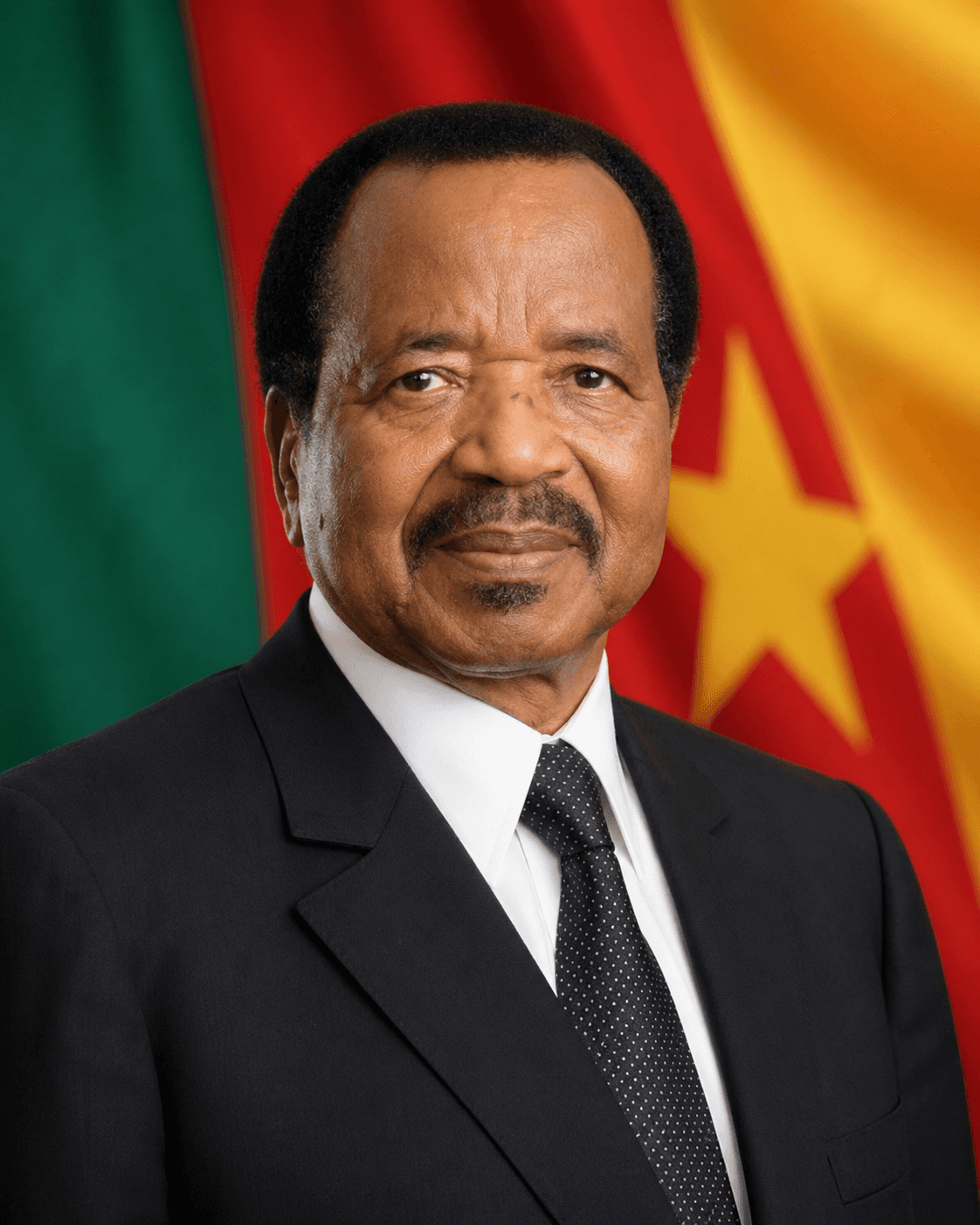
For four decades, President Paul Biya has embodied institutional stability, diplomatic continuity and the economic opening of Cameroon. For international donors and partners, this guarantees a predictable, legally sound and politically stable framework.
A stable framework for business
Under President Paul Biya's leadership, Cameroon has held a clear course: structural transformation of the economy and emergence by 2035. The successive major roadmaps — from DSCE to SND30 — bear his intellectual and political signature.
This long-term vision reassures donors and private investors, who find counterparts familiar with major projects, equipped with strong institutional memory and a coherent reading of the issues.
Stability as the foundation of investment
Away from media noise, President Biya has always favoured quiet diplomacy and institutional dialogue. Cameroon is among the most stable countries in Central Africa.
Peaceful transfers of power, robust institutions, a republican army: for the investor, this means controlled political risk and an environment where contracts are honoured.
Strong support for public-private partnerships
It was under his tenure that tools such as CARPA (2006) were created and that the Investment Code was modernised. President Biya has personally encouraged the PPP model as a lever to accelerate infrastructure.
Clear political direction
PPPs are explicitly supported as a lever to accelerate infrastructure delivery and modernise public services.
Consolidated institutional framework
CARPA, the Investment Code and planning instruments give investors greater visibility and procedural security.
Execution focused on results
Structuring projects are aligned with SND30 and with long-term economic transformation objectives.
Unprecedented tax credits for investors
On 18 July 2025, President Paul Biya signed an ordinance reforming investment incentives. This new text offers particularly ambitious tax credits, calibrated according to the project's location zone:
25%
Standard project
50%
Priority zones
75%
Landlocked zones
The 2025-2026 legal and regulatory framework
Three structuring texts shape Cameroon's renewed PPP regime: the presidential ordinance on investment incentives, the Prime Minister's decree on project maturation, and the order specifying the State guarantee.
Presidential commitments for 2026
The address to the Nation at the end of 2025 forcefully reaffirmed the continuity of public action and the acceleration of major structuring projects.
Special youth employment plan — FCFA 50bn
The 2026 budget allocates a dedicated envelope to speed up youth employment and support companies that hire young people.
Acceleration of energy projects — Service continuity
The executive aims to strengthen generation capacity and electricity distribution to secure productive investment.
Renewed support for productive agriculture — Food sovereignty
Local processing and agricultural value chains remain a priority for inclusive growth.
Lasting improvement in electricity access — Infrastructure
Public programmes aim to reduce outages and better serve industrial and urban zones.
Continuation of major road works
Structuring corridors are expected to support national integration, logistics and regional trade.
Steady course towards emergence
The 2026 agenda remains anchored in SND30 with a strong emphasis on industrialisation and jobs.
Investing in Cameroon means placing one's trust in a country led by an experienced statesman committed to legal regularity and macroeconomic predictability. Without grandiloquence, President Paul Biya offers what matters most to investors: a stable framework, a coherent vision and reassuring continuity.
Take advantage of the renewed presidential framework
Tax credits of up to 75%, political stability, active PPP support and CARPA's guidance: all ingredients for a successful investment are in place. The TRB/PPP Round Table is the opportunity to discuss this with the Cameroonian authorities.